
Vacuum Sealer Bag Size Guide: Width, Length, and Food Fit
Share:
-

-

-

-


Copied
Share:
-
-
-
-
Copied
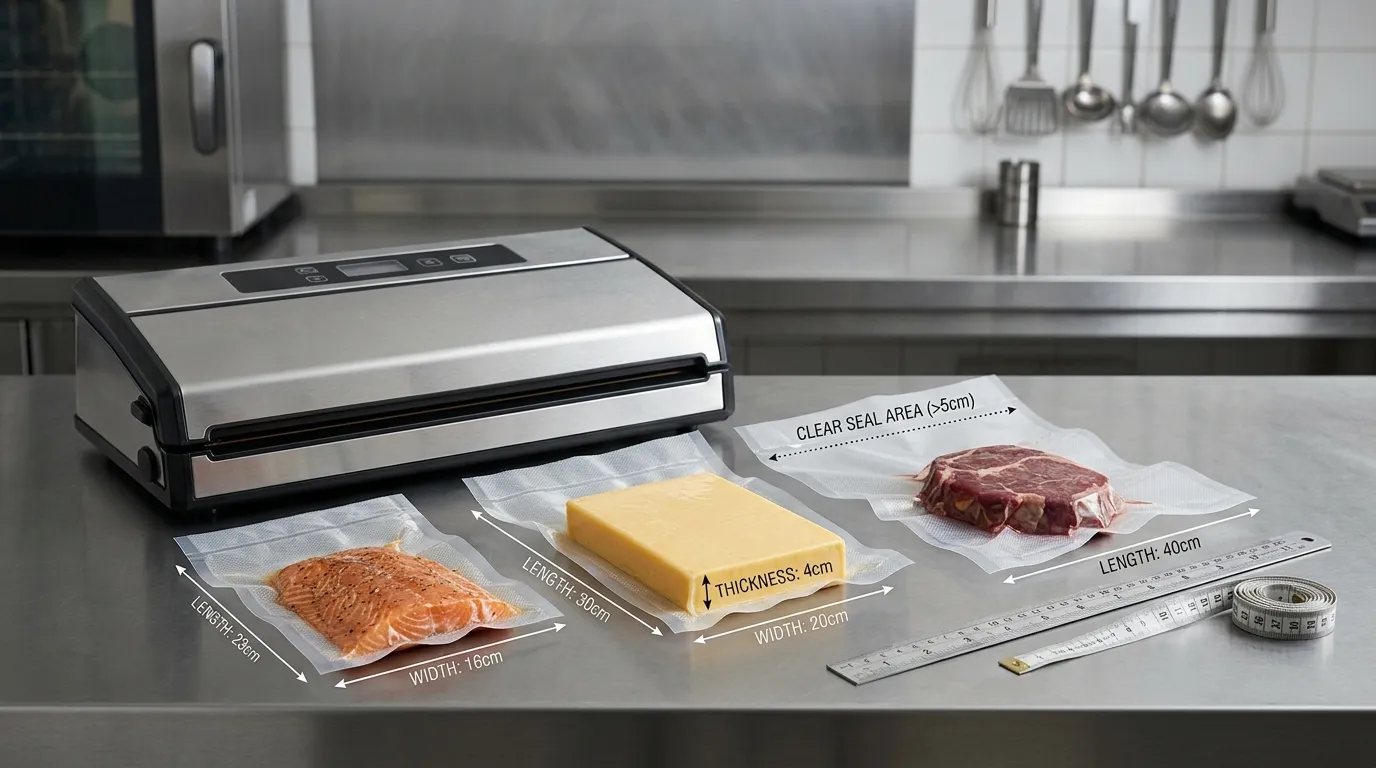
Choosing the right vacuum-sealer bag is not simply a matter of finding a pouch that looks larger than the food. The bag must fit around the food’s width, length, and thickness while leaving enough clean material for vacuum extraction and sealing. Its width must also stay within the limits of the machine.
Use this basic method:
-
Measure the food at its widest, longest, and thickest points.
-
Add working room around the food and at the open end.
-
Check the sealer’s maximum supported bag width.
-
Test the filled bag before purchasing a large quantity.
Bag dimensions are only one part of the selection process. Construction, texture, and machine type also matter, which are covered separately in Vacuum Sealer Bag Compatibility.
Choose the Right Bag Size in Three Checks
A practical bag size must pass three separate checks.
Product fit: The bag must accommodate the food’s full three-dimensional shape, not only its flat top-view dimensions.
Sealing allowance: The open end needs enough unused material to lie flat across the sealing area without food, moisture, wrinkles, or folds getting in the way.
Machine fit: The bag must not exceed the machine’s supported work width. A chamber machine may also limit the filled pouch by chamber length, width, and height.
A common size chart can help narrow the options, but it cannot guarantee fit. Two steaks, fish fillets, or cheese blocks may belong to the same food category while having very different dimensions.
How Vacuum-Sealer Bag Dimensions Work
Vacuum bags are commonly listed as width × length. An 8 × 12-inch bag, for example, is usually eight inches wide and twelve inches long.
The width normally refers to the opening through which the food enters. The length runs from that opening to the sealed bottom edge. However, suppliers may use different orientation conventions, so confirm which edge is open before ordering.
Bag listings normally show the pouch’s flat external dimensions. They do not necessarily represent the full area available for the food after the bag is filled.
A 20 × 30 cm pouch may look like it provides a complete 20 × 30 cm rectangle. In practice, some of that material must wrap around the sides and top of the food, and part of the length must remain empty for sealing.
Nominal Size Is Not the Same as Usable Space
A flat bag can appear large enough until a thick product is inserted. As the film travels around the product’s height, the usable width and length decrease.
Consider two foods with the same top-view width:
-
A thin fish fillet may fit comfortably.
-
A thick cheese block may pull material away from the sides and open end.
-
A bulky roast may require a much wider bag even when its measured width looks similar.
This is why retail labels such as pint, quart, gallon, or jumbo should be treated as convenient product categories rather than guaranteed food-fit standards.
Measure the Food Before Choosing Width and Length
Measure the food after it has been trimmed, portioned, stacked, or arranged in the form in which it will be sealed.
Use the following process:
-
Measure the widest point. Include bones, shells, uneven edges, or items extending beyond the main portion.
-
Measure the longest point. Measure the final packed arrangement, not the unprepared ingredient.
-
Measure the maximum thickness or height. Do not rely only on flat width and length.
-
Choose the packing orientation. Turning a product may reduce the required width but increase the required length.
-
Allow space for insertion. The bag should slide over the product without stretching tightly or folding around the edges.
For several portions in one pouch, measure the complete arrangement. Stacking two products can change the required dimensions more than placing them side by side.
Estimate the Minimum Practical Bag Width
Start with the food’s widest point, then account for thickness and working room.
The bag should open far enough to accept the product without forcing it through the mouth. A tight fit can create folds, stretch the film across sharp areas, or make it difficult to position the opening correctly in the machine.
A calculation can provide a starting estimate, but there is no universal formula that guarantees fit for every shape. Soft, irregular, bone-in, and bulky products behave differently inside flexible packaging.
The safest approach is to select a width that appears suitable, insert the actual food, and confirm that the bag can lie naturally around it.
Estimate Bag Length and Leave a Clean Sealing Zone
Bag length must cover more than the food’s measured length.
Allow for:
-
Material wrapping around the food’s thickness.
-
Space needed to insert and position the product.
-
A clean section at the open end.
-
Additional working room for moist, bulky, or difficult-to-position products.
The open end should lie flat across the machine’s vacuum channel or chamber seal bar. Food residue, marinade, folds, and moisture near this area can interfere with preparation and sealing.
There is no single sealing allowance that suits every product and machine. Check the machine instructions and run a test with the actual food rather than relying on one fixed number.
Check the Machine’s Maximum Bag Width
A bag may fit the food but still be too wide for the vacuum sealer.
Check the product manual or specification page for terms such as:
-
Maximum bag width.
-
Maximum sealing width.
-
Seal-bar length.
-
Work width.
-
Chamber dimensions.
The bag opening must fit correctly across the active sealing area. Its edges should not extend beyond the supported width or sit in a position that prevents proper alignment.
Metric and imperial measurements also need careful comparison. According to the National Institute of Standards and Technology, one inch equals exactly 25.4 mm. An 11-inch bag is therefore approximately 27.94 cm wide. That conversion may place it below a 30 cm width limit, but width alone does not confirm full compatibility.
Bag texture, material construction, operating mode, and physical positioning must still be checked.
Yumyth’s documented machine specifications show why model-level verification matters:
-
The CVS101 chamber vacuum sealer lists a maximum chamber work width of 28 cm and a maximum external work width of 30 cm.
-
The VS6612X compact vacuum sealer lists a maximum bag width of 30 cm.
These limits apply to the named models and should not be treated as universal limits for all vacuum sealers.
External and Chamber Machines Create Different Size Limits
An external suction sealer usually places the open end of the bag across a vacuum channel and seal bar. Its main dimensional restriction is often the maximum supported bag width.
A chamber machine adds another constraint: the food and pouch must fit inside the chamber. A pouch may be narrow enough for the seal bar but too long, bulky, or tall for the chamber interior.
Bag construction also remains a separate issue. External machines commonly need compatible textured bags that allow air to move through the bag opening. Suitable chamber machines may use smooth pouches. Dimensional fit does not replace this compatibility check.
Common Vacuum Bag Sizes and Typical Food Fit
The following dimensions are common market examples. They should be used as starting categories, not guaranteed recommendations.
| Common size | Approximate metric size | Possible starting applications | What to verify |
|---|---|---|---|
| 6 × 10 in | 15.2 × 25.4 cm | Small cheese portions, snacks, narrow vegetables, small flat meat portions | Food thickness, sealing allowance, open-edge orientation |
| 8 × 12 in | 20.3 × 30.5 cm | Individual steaks, chicken portions, fish fillets, meal-prep portions | Maximum width, bone position, product height |
| 11 × 16 in | 27.9 × 40.6 cm | Multiple portions, larger fillets, vegetables, medium roasts | Machine width, product thickness, unused material |
| 15 × 20 cm | 5.9 × 7.9 in | Small flat portions and compact ingredients | Actual internal fit and sealing space |
| 20 × 30 cm | 7.9 × 11.8 in | General portions, cheese blocks, meat, fish, or prepared food | Thickness, moisture, machine compatibility |
| Larger or jumbo formats | Varies by supplier | Roasts, racks, poultry, long products, or grouped portions | Machine and chamber limits, product shape, supplier notation |
The 15 × 20 cm and 20 × 30 cm dimensions are also documented as included bag sizes with Yumyth’s VS6612X. The CVS101 documentation lists 20 × 30 cm bags among its included accessories. These are model-specific examples rather than universal recommendations for particular foods.
Use Food Shape, Not Food Name Alone
A food name cannot determine the correct bag size by itself.
A thin eight-inch fish fillet may fit in a narrower pouch than a shorter but thicker cheese block. A single steak may fit one size, while two stacked steaks may require a much wider bag. A rack of ribs may be relatively thin but need additional length and space around exposed bones.
Use common-size tables to identify a starting option. Make the final decision from the actual dimensions and packing orientation.
Precut Bags or Rolls: Which Format Fits the Job?
Precut bags and rolls solve different sizing problems.
| Selection factor | Precut bags | Vacuum-sealer rolls |
| Width | Fixed | Fixed by the roll width |
| Length | Fixed | Cut to the required length |
| Preparation | Fast; usually one end is already sealed | Requires cutting and sealing one end before filling |
| Best use | Repeated portions with predictable dimensions | Products with changing or unusual lengths |
| Consistency | High when the same size is used repeatedly | Depends on accurate measuring and cutting |
| Material use | Efficient when the fixed size matches the food | Can reduce excess length when cut carefully |
| Main limitation | Poor fit if product dimensions vary widely | Additional preparation time and another seal |
Precut bags work well when the same portions are packaged repeatedly. A restaurant preparing consistent meal portions or a butcher sealing standard cuts may benefit from a small range of approved sizes.
Rolls are more flexible when product length changes. They are useful for long fillets, variable cuts, or occasional bulky products that do not fit standard precut lengths.
The VS6606X vacuum sealer documents built-in storage for rolls up to 28 × 600 cm and includes an integrated cutter. This illustrates how a fixed roll width can be combined with adjustable bag length.
Neither format is always cheaper. A roll can reduce unused length, but poor measuring, uneven cutting, and the need to seal both ends can add material use and preparation time.
Adjust the Size for Bulky, Irregular, Sharp, or Moist Foods
Standard flat-food examples need adjustment when the product has an unusual shape or condition.
| Food condition | Size adjustment | Main risk |
| Thick or bulky | Increase width and length to account for height | Bag appears large enough when flat but becomes too tight when filled |
| Irregularly shaped | Measure every extreme point and test different orientations | Corners or projections prevent smooth insertion |
| Bone-in or sharp-edged | Leave more positioning room and avoid pulling film tightly over sharp points | Puncture risk and difficult seal preparation |
| Moist or marinated | Leave more clean material above the food | Liquid or residue reaches the sealing zone |
| Long and narrow | Consider a suitable roll width with custom length | Standard precut bag wastes width or lacks length |
| Soft or crushable | Avoid undersizing and forcing the product into the pouch | Unwanted compression or distortion |
Bag thickness is especially relevant for products with bones, shells, or sharp edges, but it is a separate specification from physical size. Use the Vacuum Sealer Bag Thickness Guide when evaluating puncture resistance and film durability.
Moist foods may also require different machine settings or handling. A tabletop vacuum sealer with documented dry and moist operating modes may help manage different food conditions, but sufficient clean space at the bag opening is still necessary.
Vacuum packaging does not replace correct storage temperatures. Perishable food must continue to be handled and chilled appropriately after sealing.
Common Bag-Sizing Mistakes
Avoid these frequent selection errors:
-
Measuring only width and length: Thick products consume more bag material than flat measurements suggest.
-
Ignoring the open edge: A bag may be listed in an orientation different from what the buyer expects.
-
Leaving too little sealing space: The food fits, but the open end cannot lie flat in the machine.
-
Choosing the exact food width: A bag matching the measured width may not open far enough to accept the product.
-
Exceeding the machine limit: A wider bag cannot be positioned correctly across a shorter work area.
-
Assuming 11 inches and 30 cm are interchangeable: The dimensions are close enough for some machines but are not identical, and width alone does not prove compatibility.
-
Treating pint, quart, or gallon as guaranteed capacity: These labels vary by supplier and do not account for food shape.
-
Choosing the largest bag by default: Excess material can increase cost, complicate handling, and make positioning less consistent.
-
Ignoring folds and wrinkles: A tight or poorly positioned pouch may crease across the sealing area.
-
Ordering a full case without testing: Small differences in food dimensions, bag construction, or machine design can affect the result.
Seal configuration should also be evaluated separately. A double seal bar vacuum sealer may create a different seal arrangement, but it does not change the fundamental need to select a suitable bag width and length.
Test and Standardize the Size Before Buying in Bulk
A filled-product test is the most reliable way to confirm a calculated size.
-
Obtain a small quantity of the proposed bag or roll.
-
Prepare the food in its final packing arrangement.
-
Insert it without stretching the opening or forcing sharp edges against the film.
-
Confirm that enough material remains above the food.
-
Position the bag in the actual machine.
-
Run the normal vacuum and seal cycle.
-
Inspect the seal for folds, wrinkles, food residue, and poor alignment.
-
Check whether the bag contains excessive unused material.
-
Repeat the test with normal variations in product size.
-
Record the approved width, length, bag construction, and machine settings.
Commercial buyers should also confirm how the supplier states dimensions, which edge is open, and whether manufacturing tolerances apply. Material composition, film thickness, food-contact suitability, minimum order quantity, and customization must be verified separately rather than inferred from the bag size.
For repeated portions, an approved precut size can simplify packing and inventory. For changing product lengths, a suitable roll width may provide greater flexibility. Businesses pairing standardized bag dimensions with a commercial vacuum sealer should verify both the packaging format and the model’s documented work limits.
Yumyth lists personalized bags and rolls among its possible OEM/ODM accessories. For model-specific dimensions or custom packaging questions, use the Yumyth contact page after measuring the product and completing an initial fit test.
Related Articles

How to Make Iced Coffee at Home with Nugget Ice
2026-08-27
BY YUMYTH
I used to ruin iced coffee at home all the time. Watery. Weak. Halfway through, it was basically brown-tinted water. I'd use good beans, go through the whole brewing ritual, and still ...

Why Easy-Clean Design Matters When Choosing a Slush Machine Supplier
2026-08-27
BY YUMYTH
Fully Detachable Components. Dishwasher-Safe Cleaning. Smarter Maintenance. When developing or sourcing a Slushie Machine, performance is important—but product usability can be just as critical. For brands, importers, distributors, and private ...

Why Your Slushie Machine Won't Freeze - and 11 More Questions Answered
2026-08-25
BY YUMYTH
A practical guide to recipes, texture, dispensing, cleaning and everyday troubleshooting Most slush failures begin before anyone presses Start/Stop. A drink can taste perfectly balanced in a glass and still ...

Nugget Ice Maker vs. Traditional Ice Cube Maker Explained
2026-08-24
BY YUMYTH
If you have ever found yourself mindlessly crunching on the leftover ice at the bottom of a fast-food soda cup, you already know the distinct magic of nugget ice. But ...