
Ice Maker Troubleshooting: 9 Problems B2B Buyers Should Evaluate
Share:
-

-

-

-


Copied
Share:
-
-
-
-
Copied
A practical guide to ice quality, reliability, alarm logic, operating noise, and honest production claims.
For an importer, distributor, private-label brand, hospitality supplier, or premium appliance retailer, a catalog specification is only the beginning of ice maker evaluation. The more important questions appear after ice maker machines operate across different water conditions, ambient temperatures, duty cycles, and end-user environments.
Whether the project is a home ice maker machine for private-label retail or a countertop ice maker for offices and hospitality, a professional supplier should explain why failures occur, how the design reduces risk, and under which conditions every performance claim was tested. The following nine issues help B2B buyers separate normal ice characteristics from component, structural, sensing, or calibration problems.
1. Why Is an Ice Maker Not Making Ice?
A no-ice symptom is not a complete diagnosis. Basic conditions such as power supply, water supply, ventilation, ambient temperature, and installation clearance should be checked first. If these are normal, two deeper causes deserve particular attention.
- Refrigerant leakage. If the sealed refrigeration circuit loses charge, the evaporator may not reach or maintain the temperature required to freeze water. A qualified technician should confirm the fault; refrigerant work is not a user-service task.
- Power-board or control-board component failure. Relays, drivers, connectors, sensors, or other electronic components can interrupt the operating sequence even when the machine has power.
B2B sourcing implication: Ask the ice machine maker about refrigeration-circuit leak testing, electrical safety checks, board protection, functional burn-in, fault-code logic, and spare-part availability. These controls are especially important for a portable ice maker or small ice maker machine that may be sold across many markets and operating conditions.
2. Why Are Some Ice Cubes Cloudy Instead of Transparent?
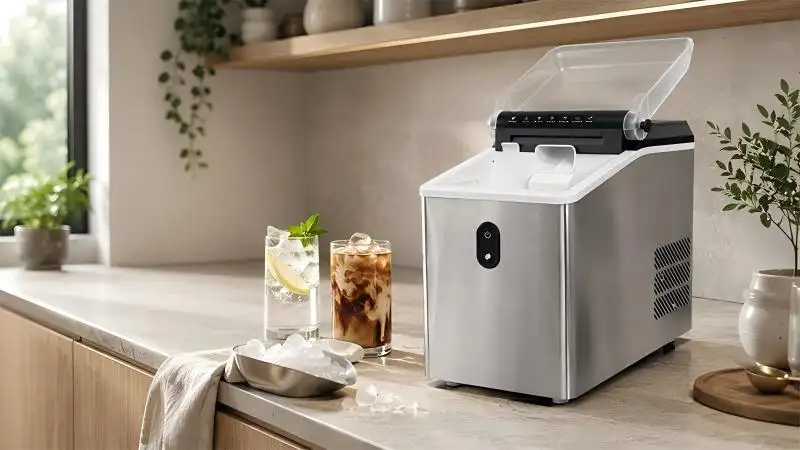
Ice clarity is not a universal quality grade; it must be judged against the intended ice type. Cloudiness usually comes from tiny air bubbles and dissolved minerals trapped as water freezes. Water movement and a controlled freezing direction help move gases and impurities away from the freezing surface, but source-water quality, temperature, mold geometry, and cycle control also influence the result.
The Yumyth YJ2001 nugget ice maker produces semi-transparent chewable ice by design. Its priority is a soft, compressible texture rather than cocktail-style optical clarity. By contrast, the YF1201 clear ice maker uses a controlled water-flow and freezing process to produce transparent large square cubes. A professional product page should show the ice that the machine actually makes under stated conditions, rather than applying the same visual expectation to every ice format.
For buyers comparing an ice cube maker, square ice cube machine, or clear ice maker countertop model, request unedited production samples and a video of a complete cycle. This is the most direct way to verify that the supplier's images, texture description, and real output are consistent.
3. Why Do Ice Cubes Stick Together in the Storage Bin?
Most compact ice makers use an insulated storage bin, not a refrigerated freezer compartment. Over time, heat entering the bin can create a thin film of meltwater on the ice surface. When adjacent pieces touch, that moisture can refreeze and cause clumping. Surface moisture from the production process and long storage time can increase the effect.
Yumyth ice maker machines use foamed insulation around the storage area to slow heat transfer. This helps the ice remain separated for longer and improves short-term holding performance. It does not mean that ice can remain loose indefinitely. For the best user experience, finished ice should still be transferred to a freezer when long-term storage is required.
B2B sourcing implication: Compare insulation coverage, foam density and consistency, lid sealing, bin geometry, drainage, and real holding-time tests. A credible supplier should define what 'longer separation' means under a stated ambient temperature.
4. Why Does Ice Fail to Release or Drop?
A failed harvest or discharge event is commonly linked to one of two areas. First, a solenoid or harvest valve may not energize or open correctly, preventing the heat, water, or mechanical action needed to release the ice. Second, the ice path, mold, scraper, chute, or discharge mechanism may have insufficient clearance or an unfavorable geometry that allows ice to bridge or jam.
The Yumyth YJ2001 nugget ice maker, YF1201 clear square ice maker, and YZ1201 bullet ice maker use product-specific harvest and discharge structures designed to minimize sticking and incomplete release. The responsible B2B claim is repeatable release performance under validation testing, not an absolute promise that no unit can ever encounter a blockage.
B2B sourcing implication: Request repeated-cycle testing, including hot and cold ambient conditions, low and high water levels, and an inspection of the ice path after extended operation. A release system should be evaluated as a combination of valve response, structure, timing, and control logic.
5. What Causes a False Low-Water Alarm?
Two common approaches are used to determine whether water is available. A conductive probe detects an electrical path through the water. Because distilled or highly demineralized water has very low conductivity, a basic probe system may fail to recognize it unless the sensing circuit is designed for that range. A pump- or flow-based system instead evaluates circulation behavior and is less dependent on the water's ionic content.
Yumyth ice makers use pump- and flow-based water-detection logic to avoid the distilled-water blind spot associated with basic conductivity probes. This architecture reduces the risk of a false low-water alarm across different water types. Final validation should still cover the actual water conditions expected in the destination market.
B2B sourcing implication: Test tap, filtered, reverse-osmosis, and distilled water as applicable. Confirm the alarm threshold, reset behavior, dry-run protection, and whether mineral scale or bubbles can affect the detection logic.
6. What Causes a False Ice-Full Alarm?
Many ice makers use an infrared emitter and receiver across the bin or discharge path. When ice blocks the beam for the programmed confirmation period, the controller interprets the bin as full. False alarms usually trace back to three design variables.
- Emitter and receiver specifications. Optical power, sensitivity, beam angle, wavelength, tolerance, and temperature behavior must be matched to the application.
- Mechanical positioning and fixation. The emitter and receiver must remain aligned after transportation, vibration, assembly variation, and repeated thermal cycling.
- Program logic. Debounce time, confirmation duration, retries, and recovery rules determine whether a brief interruption becomes a false shutdown.
In field use, scale, condensation, debris, a loose harness, or a damaged wire can create similar symptoms. High-end B2B evaluation should therefore cover both design robustness and service diagnostics.
7. Why Is an Ice Maker Noisy or Prone to Vibration?
Operating sound may come from the compressor, condenser fan, water pump, auger or gearmotor, ice impact, or resonance between the internal assembly and cabinet. A machine can use acceptable individual components and still feel noisy if the mounting points, tolerances, acoustic insulation, or control sequence allow vibration to transfer into the housing.
Under Yumyth factory test conditions, the YZ1201 bullet ice maker, YJ2001 nugget ice maker, YF1201 square ice maker, and YX1801/YX1802 slush machines are measured at no more than 55 dB. For a meaningful comparison, B2B buyers should request the measurement distance, ambient background level, machine mode, load condition, and test method.
B2B sourcing implication: Evaluate both the sound-pressure result and the character of the sound. Intermittent rattles, cabinet buzz, or start-stop impacts can create more customer complaints than a stable fan sound with the same average reading.
8. Why Do Some Ice Makers Have a Short Service Life?
In a compact electric ice maker, the pump, fan, and power/control board are important lifetime drivers because they operate repeatedly and are exposed to moisture, heat, vibration, and electrical cycling. Overall service life also depends on the compressor and sealed system, water quality, ventilation, cleaning, duty cycle, and user maintenance.
Critical components used across Yumyth bullet, nugget, and square ice maker platforms are validated against a three-year design target under factory test standards. This statement describes an engineering validation basis; the commercial warranty, spare-parts commitment, and service terms should be stated separately in the supply agreement.
B2B sourcing implication: Ask for component specifications, endurance-test conditions, failure criteria, supplier traceability, PCB moisture protection, fan and pump cycle tests, and a spare-parts plan. Premium positioning must be supported by documentation, not only by exterior design.
9. Why Is Actual Ice Production Lower Than the Advertised Figure?
Twenty-four-hour output is meaningful only when the test conditions are defined. Ambient temperature, inlet-water temperature, voltage, ventilation, water quality, scale accumulation, and the selected ice thickness can all change production. Buyers should be cautious when a supplier publishes a maximum number without describing how it was measured.
Yumyth positions its output figures as factory-tested production ratings rather than inflated marketing numbers. Based on the current product data supplied for this article, the relevant models are summarized below.
| Model | Ice type | 24-hour output | Positioning note |
| YJ2001 | Nugget / chewable ice | 20 kg per 24 hours | Semi-transparent texture; 55 dB or less under factory test conditions |
| YZ1201 | Bullet ice | 12 kg per 24 hours | Compact bullet format; 55 dB or less under factory test conditions |
| YF1201 | Large clear square ice | Confirm in final data sheet | Transparent cube process; 55 dB or less under factory test conditions |
Before signing a supply agreement, request a 24-hour test report with the agreed ambient temperature, inlet-water temperature, voltage, ventilation clearance, and measurement method. For random-lot verification, the same conditions should be reproducible during pre-shipment inspection.
A Practical B2B Ice Maker Sourcing Checklist
- Verify the ice itself. Approve real samples for shape, clarity, texture, size, melt behavior, and separation time.
- Define rated conditions. Put ambient temperature, inlet-water temperature, voltage, and ventilation conditions beside every output claim.
- Validate complete cycles. Review start-up, freezing, harvest/discharge, bin-full stop, low-water stop, reset, and restart behavior.
- Test water variability. Use the water types expected in target markets, especially when evaluating low-water detection.
- Measure acoustic performance. Record distance, operating mode, background noise, and whether the result is an average or maximum.
- Review lifetime evidence. Request pump, fan, board, motor, compressor, and repeated-cycle validation appropriate to the model.
- Confirm serviceability. Agree on diagnostics, spare parts, repair guidance, warranty scope, and after-sales response.
- Audit marketing consistency. Make sure product images, videos, specifications, samples, packaging, and manuals describe the same product.
- Plan OEM/ODM execution. Confirm branding, color, packaging, language, plug, voltage, documentation, and market-specific compliance requirements before mass production.
Choose a Supplier That Can Explain the Engineering
For premium B2B programs, product quality is not defined by one attractive photo or one maximum production number. It is defined by repeatable output, appropriate ice characteristics, stable harvest performance, reliable sensing, controlled noise, validated components, and transparent test conditions.
Yumyth manufactures bullet ice makers, nugget ice makers, large clear square ice makers, and slush machines for international B2B customers. Buyers can request model data sheets, production samples, factory test information, OEM/ODM options, packaging plans, and market-specific project documentation for evaluation.
Editorial Validation Sources - Remove Before Website Publication
These official manufacturer and instrumentation references were used to check the technical framing. They are included for the marketing and engineering teams, not as required links in the published article.
- Hoshizaki service manual - control board, refrigeration, and harvest valve diagnostics
- Scotsman service manual - conductivity water sensing and infrared photo-eye bin control
- Scotsman service manual - false bin-full diagnostic examples
- Scotsman product service document - circulated spray water and crystal-clear cube formation
- Endress+Hauser instrument manual - minimum conductivity considerations for demineralized water
Related Articles

How to Make Iced Coffee at Home with Nugget Ice
2026-08-27
BY YUMYTH
I used to ruin iced coffee at home all the time. Watery. Weak. Halfway through, it was basically brown-tinted water. I'd use good beans, go through the whole brewing ritual, and still ...

Why Easy-Clean Design Matters When Choosing a Slush Machine Supplier
2026-08-27
BY YUMYTH
Fully Detachable Components. Dishwasher-Safe Cleaning. Smarter Maintenance. When developing or sourcing a Slushie Machine, performance is important—but product usability can be just as critical. For brands, importers, distributors, and private ...

Why Your Slushie Machine Won't Freeze - and 11 More Questions Answered
2026-08-25
BY YUMYTH
A practical guide to recipes, texture, dispensing, cleaning and everyday troubleshooting Most slush failures begin before anyone presses Start/Stop. A drink can taste perfectly balanced in a glass and still ...

Nugget Ice Maker vs. Traditional Ice Cube Maker Explained
2026-08-24
BY YUMYTH
If you have ever found yourself mindlessly crunching on the leftover ice at the bottom of a fast-food soda cup, you already know the distinct magic of nugget ice. But ...